Capturing Cricket Green’s character

There is something very special about the character of Cricket Green.

It is widely recognised by those who live here and visitors often comment on the village-feel, our greens, a sense of history and the mix of interesting buildings.

We always ask developers to respect this character when they come forward with new buildings and it is important to protect it.

Describing Cricket Green’s character isn’t easy. It’s a complex place shaped over centuries of development and change. The task has been taken on by Merton’s new Character Study which is being consulted on by Merton Council.

We’ve welcome the study. It is much needed and a vital complement to the new Local Plan that will guide development well into the 2030s.

Merton Council has already had one false start when it produced studies for 22 of Merton’s 36 character areas between 2011 and 2015 but failed to finalise them and give them legal weight when planning decisions are made.

The new Character Study misses out on the richness of the unfinished work. By providing an assessment of the complex character of Cricket Green in just 103 words it leaves our special neighbourhood short changed.

The earlier Character Study now being set aside devoted over 1,400 words to Cricket Green.

Merton Council’s approach to preparing the Character Study means it owes more to the view of external consultants than local communities. Despite years of asking to be involved there has been only limited consultation and the character descriptions of 20 out of the 36 neighbourhoods across the Borough are informed by comments from fewer than ten people.

We have stressed the importance of recognising Mitcham as a village and addressing the importance of our registered greens and the special qualities of Mitcham Common. We have welcomed Merton Council’s acknowledgment of the importance of the historic crossing of the Wandle at Mitcham Bridge which has been misnamed in the controversy over building a new “Bishopsford Road Bridge”.

For Cricket Green we have taken Merton Council’s text and redrafted it to reflect local priorities. See our proposed changes in the graphic at the bottom of this post.

Our proposals have been informed by the work behind the Cricket Green Charter published in 2019 after we contacted over 5,000 households. The changes we propose recognise the true history of Mitcham cricket ground, put more emphasis on the important role played by mature trees and look towards the sensitive re-use of important sites such as the Wilson, Birches Close and the Burn Bullock.

Merton Council is also consulting on a draft Toolkit to secure better quality design in new buildings on the many small sites across the Borough. Sites of less than a quarter of a hectare have been responsible for over 60% of new homes built in the the borough in last 15 years.

We’ve welcomed the approach while also stressing that it will require more than the publication of a Toolkit to deliver the necessary sea change in Merton’s culture which will secure quality design informed by early community engagement and local preferences in new development.

You can read our comments on Merton’s draft Character Study here.

You can read our comments on Merton’s draft Small Sites Toolkit here.

Facelift for Bramcote Parade

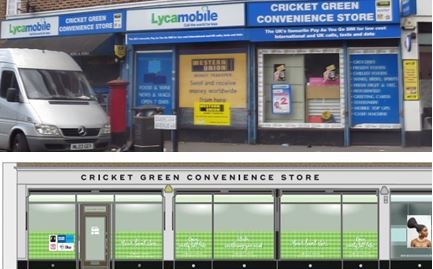
Merton Council has applied for permission to restore the shopfronts on Bramcote Parade and replace the intrusive advertising.

We’ve warmly welcomed the plans which follow our success in having Bramcote Court and Parade added to the Local List in 2017.

The work is being funded by a £90,000 allocation from the money raised by the Community Infrastructure Levy which is paid by new development.

As the images show the work will have a significant and positive impact. It will restore some of the original details of the shopfronts and reinstate the distinctive curved sweep. The shops will be much more sensitively lit at night. One consequence is that the poor design, colour and build quality of the new flats being built on the other side of the road by the formers Queen’s Head will become sadly even more apparent. Merton Council expects the work on the shop fronts to be complete this year.

It is important that the new works stand the test of time and we’ve highlighted problems with similar investment at Morden Court Parade. This has seen good work undone by changes resulting from new businesses moving in only a year or two after the facelift.

Following the rejection of our efforts to have some the oldest shops in Mitcham around Fair Green locally listed last year we’re keen to see Merton Council move on to restore these as the next priority for this welcome shopfront initiative.

You can read our submission here.


Reviewing Merton Council’s Design Review Panel

In common with many local authorities Merton Council uses a Design Review Panel to help it assess the design quality of new developments.

This is made up of external architects, urban designers, transport planners, landscape and other professional who review schemes, often well before a planning application is submitted.

We welcome design review. When operated transparently and well it can provide insight and support to raise the game in the quality of design. There are also risks, especially when it operates in a deep seated culture that views the role of the Design Review Panel as a closed group of behind-the-scenes advisors that stands separate from normal standards of public scrutiny or engagement.

Government policy is placing ever more emphasis on design quality and the role of design review and it also features in Merton’s new Local Plan. It is timely therefore to have Merton’s approach put under the spotlight by the Sustainable Communities Overview and Scrutiny Panel and we’ve drawn a number of issues and concerns to its attention in a detailed submission.

The bottom line is that Merton’s Design Review Panel is not fit for purpose.

It doesn’t meet the industry standard and Merton Council has chosen not to sign up to the Mayor of London’s Quality Review Charter.

Merton is an outlier in having the Chair of its Planning Applications Committee also as Chair of its Design Review Panel seemingly oblivious to the problems this causes.

There is evidence that Merton’s constitutional safeguards to prevent any conflict are being breached – including the then Chair of the Planning Applications Committee voting to grant planning permission for a development that was subject to design review at a meeting she also chaired.

The Design Review Panel has other failings including:

  • no agreed terms of reference
  • no details on the Panel members and why they are qualified to serve
  • no controls over the length of time Panel members serve, with some exceeding 10 years
  • no transparent mechanism for handling conflicts of interest where Panel members are
  • working on development projects in Merton
  • failures to publish reports or provide advance notice of meetings
  • holding reviews of Merton Council’s own developments behind closed doors
  • the same officer who provides professional advice on urban design also running the Design Review Panel and writing its reports
  • holding review by email despite commitments not to do so and failing to publish their contents even where meetings would otherwise be held in public
  • operating an outdated traffic light system that rates schemes as Red, Amber or Green and which is regularly abused
  • failing to design review some controversial developments, including a large block of flats on Metropolitan Open Land at Imperial Fields described by Merton Council’s design officer as an “office block in a car park”

We’ve made 22 recommendations for reforms which will guarantee the probity of design review and ensure the Design Review Panel operates transparently and effectively. These can all be delivered in six months.

You can read our submission on the Design Review Panel here

You can also see our submission as a paper for the Merton Council Sustainable Communities Overview and Scrutiny Panel meeting on 23 February 2021 here

You can watch that meeting and meetings of the Design Review Panel on Merton TV

Big change at Old Bank House

Cricket Green was briefly the commercial hub of Mitcham and the Old Bank House on Lower Green West stems from this history.

This prominent building has been underused for many years and is now the focus of a planning application to convert it into flats.

This will include extension on the sides facing both the cricket ground and Lower Green.

Done well the two extension could “complete” the building and enhance the area while doubling the floorspace. A line of coloured brick would separate the old and the new and tell the story of how it has been built.

We’ve supported the changes providing the extensions can truly match to quality of brick and stonework on the existing building. It’s a major challenge similar to that recently faced by the adjacent Cricketers flats that were required to colour match the Vestry Hall bricks.

It’s also important that the change of use doesn’t set any precedent for losing the neighbouring workshops recently vacated by London Box Sash Windows to residential. Cricket Green needs to retain business and employment at its heart and Merton’s new Local Plan should ensure this.

Any development will need to be mindful of construction impacts on the Grade II listed cottages between the Old Bank House and the Grade II listed White Hart. The historic bench mark on the Old Bank House should also be protected during construction work and into the future.

You can read our full response – Old Bank House – Feb 21.

Merton’s Local Plan – friend or foe?

Question – What do the following have in common? The fate of Mitcham cricket pavilion. Proposals for over 1,000 new flats within 10 minutes walk of the cricket ground. The future of the Wilson Hospital. Having shopping parades on London Road and Bramcote Avenue. Protecting Mitcham’s greens and village character. Keeping business and jobs alive in workshops on Lower Green West. Enjoying the avenue of trees on Three Kings Piece. Whether new tower blocks will be built in Mitcham. How many local people can afford new homes in Cricket Green. Proposals for a new road built across Mitcham Common for heavy lorries?

Answer – Merton’s new Local Plan

The fate of all of this and more depends on developers getting planning permission to make changes to our neighbourhood. The main guide to whether planning permission is given is the planning policy in Merton’s Local Plan. The Local Plan is now up for review and a new set of draft policies has been published which will last till 2035. The new Plan also earmarks eighteen sites around Mitcham for development.

It is no surprise, therefore, that a new Local Plan has prompted our most comprehensive representations yet to Merton Council about how it should plan for new building, support the community and protect the heritage, open spaces and wildlife that makes Cricket Green so special. Too much of our neighbourhood has been changing for the worse, forever, as a result of poorly located and designed new buildings and conversions and the unnecessary loss of trees, green space and heritage.

The new Local Plan is a chance to turn this around. With a strong approach driven by local needs and priorities it can be the friend that will care for Cricket Green, raise standards and turn away those who will damage our neighbourhood. In the wrong hands it could turn out to be Cricket Green’s worst enemy. We’ve set out our stall for what needs to happen. One thing is clear – much more work is needed on the Local Plan to make it fit for purpose.

Our 12,000 word submission includes proposals which seek the following:

  • Policies which can actually deliver on the Plan’s strong ambitions, including to remove disparities between the east and west of the Borough, rather than leave them as an undeliverable wish list.
  • Putting protection of Merton’s green spaces, wildlife and heritage assets at the heart of a “Spatial Vision” that currently omits them.
  • Recognising Mitcham’s village character as the centrepiece of its planning policies with a broader focus on social, community, cultural, environmental and heritage and less emphasis on encouraging anywheresville high street brands.
  • Policies to protect an inventory of identified community assets, neighbourhood shopping parades and scattered employment sites in Mitcham.
  • The addition of the Merton Dementia Hub site following announcement of its closure as a new allocation with the potential for community-led housing.
  • Strengthening 13 other development site allocations, including securing community ownership of Mitcham cricket pavilion and development at The Wilson which respects its heritage and open space.
  • Deleting the site allocations for the former Canons nursery and Raleigh Gardens car park as undeliverable following the closure of Merantun Development Ltd.
  • Deleting the site allocation at Imperial Fields which continues to be designated as Metropolitan Open Land, Green Corridor and Open Space.
  • Major strengthening of the Plan’s approach to securing high quality design, including preparation of a Design Code for Mitcham Cricket Green.
  • Recognising Mitcham’s registered Town Greens as heritage assets and identifying The Canons as one of a new local list Merton historic parks and gardens.
  • Protecting the panoramic Wandle Vista on Mitcham Common identified in award winning research.
  • Proving more protection for scattered employment sites and supporting environmental improvements on Willow Lane Industrial estate.
  • An overhaul of Merton’s weak planning policies for protecting trees, supporting an accelerated increase in the tree canopy and measures to ensure any essential tree felling is accompanied by new planting of trees of greater value.
  • Deleting the dinosaur road scheme providing another access to Willow Lane Industrial Estate which was rejected in the 1990s and which would cause unnecessary loss of Mitcham Common and damage to the Conservation Area at Aspen Gardens.
  • Providing for improved cycling conditions along Commonside West without losing any part of Three Kings Piece to a cycle lane.
  • Six additional proposals for improvements to Cricket Green’s public realm and for people on foot.
  • Strengthening policy to secure an increase in truly affordable homes and require all new homes to have opening windows in at least two different elevations.
  • A major edit to address the draft Plan’s myriad errors, grammatical mistakes and omissions and provide a structure and approach that makes sense to all who will need to use it.
  • Further public consultation on a Plan that looks at least the required 15 years ahead and is supported by much stronger evidence to back up its approach.
  • An overhaul of the measures to ensure delivery of the Plan is effectively monitored and reviewed.

You can delve deeper into our full submission here.

White Hart flats plan still falls short

Merton Council is set to decide on the latest plan to repurpose the White Hart and build flats in its car park during the next few weeks.

We have long supported some development here. It can restore the Grade II listed building and re-open the pub that lies at the very heart of the Conservation Area.

Merton Council’s draft Local Plan echoes our call for the building to be used as a restaurant or pub.

Unfortunately, the best that’s on offer in the new plan is to convert most of the listed building into flats and provide an office or something similar on the ground floor.

Merton Council turned down an earlier plan that would have damaged the Conservation Area and done nothing to restore the listed building. The developer has appealed and this appeal is now pending the decision on the latest scheme.

We have been encouraged by the opportunity to meet with the architects and discuss the revised plans but remain concerned by them persisting with the planning appeal.

The latest plan provides 18 flats and is one storey lower than the previous one. Unfortunately, this does not remove its impact on the key view of the White Hart from Cricket Green. The new flats will be visible over the top of the listed building and the characteristic hipped profile of the White Hart’s sloping roofline will be lost. They will also be highly visible over London Box Sash windows from near the new Cricketers flats.

The plan to remove all 13 trees from the site and replace them with just six of unknown quality and variety is unacceptable.

It continues the worrying local trend towards felling trees without adequate replacements despite the climate and wildlife emergencies. We’ve asked for revised plans that increase the tree canopy by at least 10%. This can be easily achieved by investing in the run down land between the current car park and Broadway Gardens. This will also benefit the residents of Highfield Court. On the plus side it is good to see a change in the plans to ensure that any new development is serviced from the rear.

The development also fails to meet Merton Council’s expectation for 40% of new homes to be affordable, offers just one three-bedroomed flat instead of the six expected by planning policy and includes some “single aspect” homes which only have windows on one side.

We’re disappointed that we must object to the new plans. It is very clear what changes need to be made to deliver what everyone wants – well designed affordable homes tucked behind the White Hart to fit in with the Conservation Area, provide more trees and restore the listed White Hart as a centre piece of the area. We stand ready to work with the developer and Merton Council to secure this result.

Read our comments on the latest plan for the White Hart here.