Slow start for Merton’s Covid-19 Active Transport Strategy

With fewer cars on the road and everyone respecting the two metre rule we are seeing local authorities across the country working hard to create more space for people.

Pavements are being widened, parking bays suspended, new cycle lanes installed, crossing times changed to favour pedestrians and rat runs blocked off to create new outdoor space.

We can hope and expect that many of these initiatives will become permanent as our lives change and adapt in the years ahead.

The Mayor of London has announced a “London Streetspace” programme in response to a possible ten-fold increase in cycling and five-fold increase in walking.

Merton Council has now launched its own Covid-19 Active and Health Travel response  in the face of a growing clamour for action. The ambition is strong Merton Council will repurpose some of our borough’s streets and key locations to serve this unprecedented demand for walking and cycling in a major strategic shift to meet our long terms sustainability and active travel goals”

But the accompanying delivery falls well short of what’s needed.

There are only 14 proposals for immediate action across the entire Borough. The document itself is undated, hard to navigate, full of links which don’t work, missing information on most of its proposals and even lacks a Merton Council logo.

We’ve identified a number of shortcomings:

1. Geographical bias. One of the standout problems with the plans is that eight of the 14 proposals are in Wimbledon. The only place in Mitcham to benefit is London Road between the White Hart and Mitcham tram stop, with plans for first a temporary cycle lane and then a permanent cycle/bus lane on opposite sides of the road. The other places outside Wimbledon to benefit are confined to three proposals on the A298 Kingston Rd/Merton High St and one for Haydons Road bridge. Without a dramatic shift in emphasis the inequalities between the east and the west of our borough will be perpetuated.  

2. Whose roads? Most the main roads in Merton are the responsibility of Transport for London and not Merton Council. The plans are silent on which of the proposals can be delivered by Merton Council and where a green light is needed from Transport for London. We need a clear strategy for what Merton Council will be delivering itself as well as what it depends on others to permit.

3. Selection criteria. The plans are silent on how the first 14 proposals have been selected. Are they the easiest to implement or those which will bring most benefit? Have choices which will slow traffic down been ruled out? Are they the schemes most likely to get funding or those which will most improve lives? What proposals have already been rejected and why? We need to know the basis on which decisions have been made as well as what has been decided.

4. Funding choices. The plan includes the commitment of £80,000 Merton Council funding but the costed proposals add up to only £19,000. It remains unclear whether the rest, and any additional proposals that might follow, are entirely dependent on funding from Transport for London or off the back of development taking place in the Borough. Given the ambition for a “major strategic shift” we need to see more than a funding bid to Transport for London as the main commitment by Merton Council to deliver change on our streets.

5. Collaboration vacuum. Local authorities across the country have tapped into the knowledge and expertise of local communities in devising their Covid-19 transport plans. Many have collaborated online and gathered ideas and proposals from the communities who know their area best. A wide range of collaboration and mapping tools are now available free of charge to local authorities to help. None of this is visible in Merton Council’s plans. Instead they are based on a seemingly haphazard mix of, says the official online document, “officer observations, feedback from business groups, local councillors and picking up residents’ concerns via social media.” Far from reaching out to involve people the plans promise to “accelerate” the limited consultation already carried out on street works.

The approach perpetuates the misguided belief that consultation causes delay and that it is about navigating the legal procedures necessary to gain permission rather than a source of ideas and inspiration. Merton Council is way behind the curve in its attitude and approach.

6. Publicity drought.The lack of publicity for the transport plans is striking and they were placed online without any announcement. Even Merton Council’s lone tweet set a strange tone in stating it was “working with” the responsible Cabinet Member Martin Whelton. To his credit Councillor Whelton was the first to announce the proposals and has engaged in the subsequent discussion on social media. Nevertheless, we need a communication strategy based on more than the social media following of a Cabinet member and we need the future of our streets and public places to be higher on Merton Council’s priorities.

7. Limited choices. The plans focus on a very limited number of ways to improve our streets and public spaces in a very limited number of places. There is so much more that can be done than replacing parking with pavements in five locations, widening pavements in five more, providing cycle lanes in four locations and putting some stickers down on the pavement outside two shops to help manage queues. Every neighbourhood should be benefiting from such measures and more space being provided in every one of Merton’s high streets and shopping areas. The phasing of traffic lights and the timing of crossings should be changed to favour pedestrians wherever possible. Existing pedestrian and cycle routes should be promoted and the plans extended to block off some roads as through routes for cars and make them available for pedestrians. Existing controls over travel plans, fly parking, pavement parking and vehicle speeds should be better enforced. We need a much more comprehensive and ambitious approach.

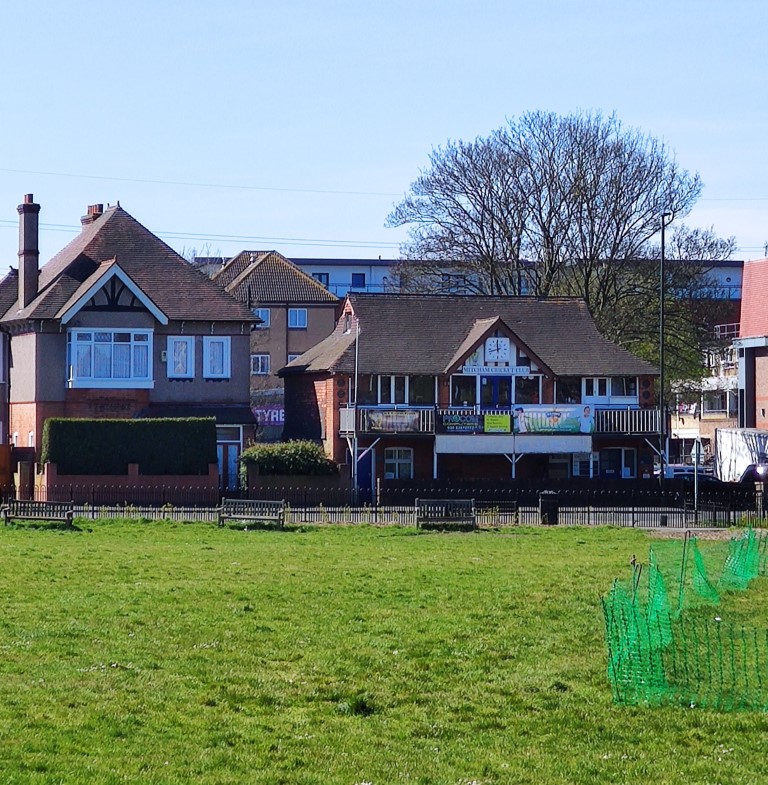
For Cricket Green having just one short cycle lane and an even shorter bus/cycle lane on the opposite side of a small stretch of London Road is a very slow start. Our Cricket Green Charter already provides a way forward for both immediate and longer term plans:

“Pedestrian routes should be enhanced throughout the area, including more pedestrian priority at road crossings and new links through Benedict Wharf, the Wilson, Worsfold House and the Birches, and to the Wandle Trail, Watermeads and Morden Hall Park.  Highways investment should support measures to reduce, calm, pacify or eliminate road traffic and reduce air pollution including: ending Lower Green West’s isolation as a traffic island; improving conditions for pedestrians in Cricket Green Road (east), Church Road, Church Path, Three Kings Pond and at Jubilee Corner and the cricket pavilion; and closing King George VI Avenue to cars.”

Immediate priorities should also include rephasing traffic and crossing lights and taking action to create space for people around Mitcham Junction station, Mitcham tramstop and central Mitcham. Heavy lorries should be banned from the narrow part of Church Road and more space provided for pedestrians along London Road from Cricket Green into Fair Green. This can all be achieved without harming the character of the area or losing green space. Let us know if you have others and they can be fed in direct to Merton Council via future.merton@merton.gov.uk.

The “major strategic shift” envisaged in Merton’s plans is ambitious and welcome. Its benefits need to be felt in every neighbourhood and to make it happen we are asking Merton Council to listen harder and collaborate more.
2019 annual review published

Tuesday 28th April 2020 should be the day of our Annual General Meeting. One of the features of this meeting is a celebration of our work in the previous calendar year.

In the current circumstances, with social distancing governing all our activities, our AGM has been postponed until later in the year, but we are still publishing our annual review.

2019 was the 50th anniversary year of Mitcham Cricket Green Conservation Area. Find out how we celebrated – including eating cake, planting a new golden privet hedge, Tweeting 50 things that make our Conservation Area so special.

Learn how we refreshed the Cricket Green Charter, and about other milestones in our year.

Even at the current time, our work continues. If after taking a look at our annual review, you would like to support us, please consider becoming a member.

Annual review 2019 screen (read on screen)
Annual review 2019 booklet (print double sided and fold into booklet)

See our other publications here

Much loved former fire station would be swamped by new flats

Mitcham’s fire station on Lower Green West served the local community for nearly one hundred years.

It has a special character and is locally listed.

It sits alongside the Vestry Hall and the new Cricketers flats as well as the nationally listed war memorial.

Its future has been uncertain ever since the new Mitcham fire station opened in 2015. Our worked up plans for a community arts centre developed with a successful community theatre company were thwarted when Merton Council chose not to exercise its right to acquire the building when it fell vacant.

The latest plans involve a near doubling in the size of the building with a massive two storey rear extension as well as conversion of the old fire station for residential use.

While welcoming the efforts to mimic the fire station doors and the plans to replace uPVC windows with aluminium frames we believe the new plans do not adequately address the sensitivities of the location or secure an appropriate future use.

The sheer scale of the extension will swamp the existing building. Lower Green West will see more clutter and light pollution. The sensitive gap between The Cricketers flats and the Vestry Hall secured after long debate over many different planning applications for The Cricketers will be blocked by a two storey building. And the setting of the listed war memorial which provides a focus for Remembrance Sunday will be damaged.

We believe a sensitive conversion and minor extension of the former fire station is possible. In achieving the right outcome we are asking Merton Council to do more than refuse planning consent. It owns the land between the fire station and the road and so can exercise real influence over what happens. We fear its ambitions will be no greater than to lease the front apron for car parking. It has already failed to take enforcement action against the intrusive hoardings on its land which have been erected without permission.

The former fire station is a much loved feature at the heart of Cricket Green. It demands the most sensitive treatment and any new building should be of a quality that could warrant listing within 30 years. The current plans fall short and we stand ready to work with the new owners to find a way forward.

Read our full comments on the plans for the former fire station Fire Station – conversion & extension – Apr 20

Basement homes too damaging for listed London Road villa

We’re fortunate in Cricket Green in having not one but two Conservation Areas.

Wandle Valley Conservation Area stretches from Watermeads to opposite the Nisa supermarket where London Road is lined by a pair of nationally listed villas. It includes the soon to be demolished Bishopsford Road bridge and the building for the oldest railway station in the world at Mitcham.

There is currently a planning application to develop three homes alongside 472 London Road. This makes up one half of one of the early 19th century Grade II listed villas. It includes the listed coach house which many will remember took on a new and very different life as a tyre warehouse for many years. The coach house is to be converted and two houses built behind it. The two new houses will involve major excavation works as they will be two storey but only one storey above ground.

The plans fall at the first hurdle for not being accompanied by an application for Listed Building Consent. This is required for any changes to the coach house.

Once the full documentation is available then we are asking Merton Council to consider the impact of the two new houses on the setting of the listed villa.

We welcome the opportunity to address the declining quality of the coach house but the grounds of the villa have already been eroded with the development of Taplow Court.

We think the two new houses cross the line of what’s acceptable without damaging the historic integrity of the villa. If the development were to be permitted then it is essential that it is preceded by a full archaeological investigation given the size of basements being proposed.

Read our full submission 472 London Road – April 2020

Justin Plaza development would block cricket pavilion

The pressure for residential development around Cricket Green can be seen in the variety of ways in which developers are finding new sites.

A few years back Justin Plaza facing London Road was converted and the promised Co-op supermarket on the ground floor never materialised.

Now there are plans to demolish the imaginatively named four storey Justin Plaza 2 office block and replace it with a six storey block of flats. This will be designed to fit in with the refurbished Justin Plaza block.

We’ve no objection to the principle of the plans although it is important the backlands behind London Road continue to provide places to work. To this end we would support the new block retaining offices on its ground floor with flats above.

Our main concern is the impact of the plans on the view from Mitcham cricket ground where, as our photo shows, Justin Plaza frames the cricket pavilion and fills the key gap between it and the Burn Bullock.

It is important that this view isn’t further damaged and any new building sits in front of the Justin Plaza flats and doesn’t break the skyline.

At six storeys the new Justin Plaza 2 will simply be too visible.

We’re asking Merton Council to refuse the application and encouraging the developers to come back with a four storey scheme that has offices on the ground floor.

Read our full response – Justin Plaza 2 – April 2020

Benedict Wharf – turning the tide

Merton Council has been clear that planning decisions carry on through Covid-19 and so, therefore, must we.

Mitcham faces a dozen simultaneous development proposals for new blocks of flats which risk changing its character for ever.  The largest of these – for Benedict Wharf – has just got larger. A whole lot larger.

SUEZ has revised its plans to increase the number of homes by over 40% to 850 and increase the height of the tower blocks to up to 10 storeys. The proposed development is far and away the largest seen in Mitcham for a generation.

And let’s not be fooled into thinking this will do anything to house those most in housing need. At best we will see some flats with a small discount on market rents for households earning up to £90,000 per year.  The average salary in Mitcham is nearer £25,000.

In this blog we explore the downsides of the current plans and why they should be rejected. But we also point towards the opportunity that Benedict Wharf can provide to open up a new future for this part of Mitcham – one which can ultimately provide even more homes, target them to match more of those in true housing need and provide green space and a well designed network of streets and houses that is recognisably Mitcham.

There are countless reasons why SUEZ’s plans are a bad way to go.

As SUEZ announced its move to a new Beddington Lane site it promised to create a legacy to be proud of. At first SUEZ invited the community in to debate the options and design the future.  We even shared a submission to Merton’s Local Plan.

And then SUEZ turned its back, closed its ears and listened only to those demanding extra height and density.

SUEZ has presented misleading information and provided false assessments of the visual impact of 10 storey blocks on the surrounding area. The plans give every impression of being designed to meet excessive housing numbers demanded by the Mayor of London as a quid pro quo for allowing the land to be repurposed from industrial to residential use.

They offer the wrong future for Mitcham.

Despite the London Plan requiring such development to be “design-led” and the Government amending the London Plan to say that “gentle densification should be actively encouraged by Boroughs in low- and mid-density locations to achieve a change in densities in the most appropriate way” we are faced with what has been labelled “Suezgrad” – an alien, excessively high and placeless development that harms the local area and feels like anything but a natural extension to Mitcham.

We have presented alternative proposals for mixed-use gentle density and these have been ignored.

The development at Benedict Wharf should respect the character of Mitcham and be led by an urban design vision that emphasises the importance of streets and houses. It should be of a height that avoids visual intrusion, shadowing and encroachment on London Road Playing Fields and negative impacts on views from the two adjacent Conservation Areas. It should rule out any possibility of being visible from either Morden Hall Park or Mitcham’s historic cricket ground. The quality of the scheme should be such that there is public pressure to include the whole site within a Conservation Area within 10 years.

Achieving this would mark a fitting transformation of Benedict Wharf with its long history of “bad neighbour” uses and provide the positive legacy which SUEZ states it wants to leave for the site.

The scheme has deteriorated so far that questions are now being raised as to whether the site might not be better in industrial use after all.

SUEZ has told us it has had offers to buy the land and use it for a distribution warehouse that are worth more financially than its use for homes. With careful controls over lorry movements there is an alternative future here which we believe is best explored through Merton’s Local Plan review.

There is a bigger prize, however, that we are asking Merton Council and the Mayor of London to recognise.

Benedict Wharf lies adjacent to the extensive Phipps Bridge estate to the north (see image).

This provides social housing through Clarion Homes. Parts of Phipps Bridge are in urgent need of renewal. When combined with the opportunity at Benedict Wharf there is potential to create a significant new Mitcham neighbourhood. By renewing Phipps Bridge this can provide a more diverse range of housing that better meets housing need. It would also reduce the likelihood of Benedict Wharf becoming a dormitory neighbourhood. Merton Council is also a landowner in the area, including development sites along Hallowfield Way.

This opportunity could provide more homes in total by making better use of under-used open land on Phipps Bridge and by taking a design-led approach, incorporating the concept of gentle density, integrating significant open spaces, and providing a streets based neighbourhood it would fit in with the local character.

An integrated approach to both Phipps Bridge and Benedict Wharf sites will deliver more homes that better meet local housing needs than can be provided by treating the sites separately. It will also meet the aims of the London Plan better than imposing unsuitably dense and tall development on Benedict Wharf.

The decision by Transport for London to route a new tram line running between the sites is a further stimulus for a re-think which takes advantage of this strategic opportunity.

This decision was made after the Mayor’s intervention on the earlier Benedict Wharf scheme which led SUEZ to increase the size of the development planned. The London Plan has also been revised by the Government since this intervention was made. These two changes alone trigger a need for the Mayor to rethink the approach. We ask him now also to recognise the strategic opportunity of a more integrated approach which supports his ambitions for estate renewal.

This is not the time to rush to a hasty decision on Benedict Wharf. It is a time to pause and see the bigger picture.

The outline planning application for Benedict Wharf has come forward ahead of the Local Plan review and it is this which should determine the future of the site and its relationship with Phipps Bridge. The Local Plan can show the way to creating a new Mitcham neighbourhood which renews Phipps Bridge, repurposes Benedict Wharf, delivers more homes overall and ensures they better meet Mitcham’s needs.

We ask Merton Council and the Mayor of London to consider the plans as they stand today premature and address these alternatives. We ask Clarion Homes to join the endeavour and promote the opportunities for estate renewal through the Local Plan review. This can be supported by a masterplan and design brief for the wider area.

Working together we can turn the tide.  We stand ready to contribute.

Read our full submission on the plans for Benedict Wharf Benedict Wharf – revised draft outline application – Mar 20